Explore the Bay of Fundy’s Hidden Ocean Paths
 By
By 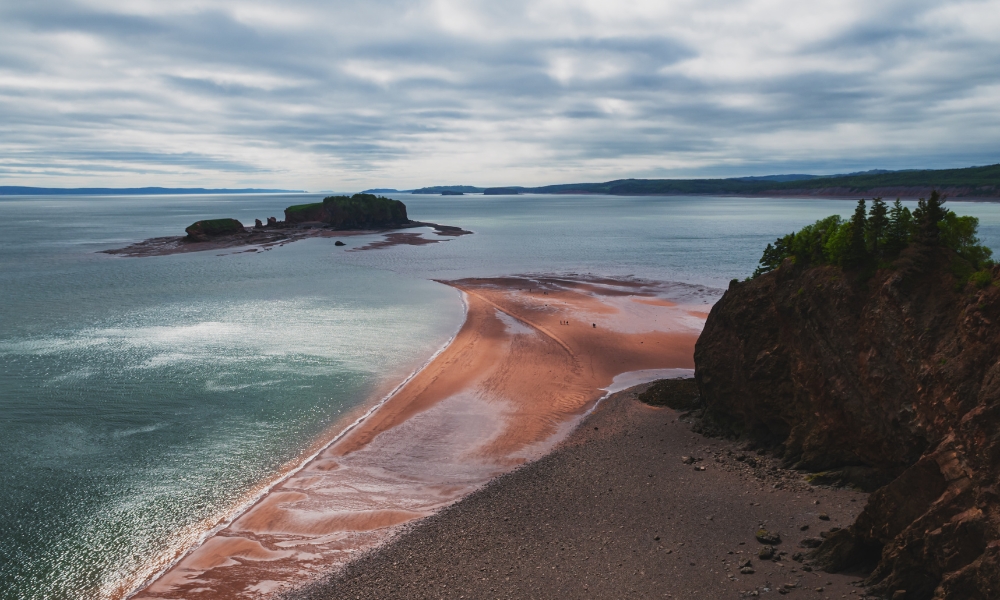 Bay of Fundy Travel
When you think of top travel destinations in the world, few places offer an experience as rare as walking across the ocean floor. Along Canada’s Bay of Fundy—home to the highest tidal range on Earth—you encounter a landscape that transforms every few hours. As the tides rise and fall, they reveal stretches of seabed, sculpted cliffs, and tidal islands accessible only for a brief window each day. For travelers looking for must-see destinations shaped by nature, this region delivers a remarkable mix of adventure and quiet discovery.
The Journey to Ministers Island
Your introduction to this phenomenon often begins at Ministers Island, a tidal island near the town of St. Andrews in New Brunswick. To reach it, you must cross a narrow, one-kilometer path that appears only during low tide. For a few hours, it becomes a walkable route of sand, gravel, and barnacled stones; once the tide returns, nearly six meters of water cover the trail again.
It’s an experience that feels almost unreal—walking where waves sweep twice a day, watching locals dig for clams, and moving across terrain shaped by the North Atlantic’s force. Ministers Island is more than a pathway; it’s a historical escape once used as a private summer retreat, still dotted with trails, heritage buildings, and quiet coastal views.
Living by the Rhythm of the Bay of Fundy
Life in this region revolves entirely around the tides. Roughly 160 billion tonnes of water rush into the bay each tidal cycle—more than all the world’s freshwater rivers combined. This dramatic movement raises and lowers the water level by up to 12 meters, creating an ever-changing coastline and a series of top travel destinations for adventure travelers, families, and nature enthusiasts.
These natural forces shape everything: wildlife feeding patterns, local traditions, and the exact timing of when you can explore the ocean floor. Planning is essential here, especially if you want to walk safely across tidal zones or join boat excursions scheduled around low tide.
Wildlife Encounters at Sea
One of the region’s most popular attractions is whale watching, made possible by the nutrient-rich waters that draw marine life into the bay. As you follow the tidal cycle to your next stop, you may board a Zodiac boat from St Andrews to search for species like minke and fin whales. A dozen species feed in these waters throughout the year, making this one of the best places to visit for marine wildlife.
On these excursions, travelers often spot porpoises, seabirds, and tidal whirlpools—including the Old Sow, one of the world’s largest whirlpools—formed where fast-moving tides collide at the western edge of the bay. It’s a reminder of how powerful and unpredictable Fundy’s currents can be.
Hopewell Rocks: Iconic Landmarks of the Bay
Continuing along the coast brings you to one of the bay’s most iconic landmarks: Hopewell Rocks Provincial Park. Here, you see towering sea stacks rising from the ocean floor, topped with trees and shaped by thousands of years of tidal erosion. At high tide, they appear as tiny islands; at low tide, you can walk among them as if exploring a natural sculpture garden.
These formations carry deep cultural significance, reflected in First Nations stories passed down through generations. The rocks’ shapes have inspired legends and serve as reminders of the region’s long human history. Visiting at both high and low tide gives you a full sense of how dramatically the landscape shifts.
 Walking on Ocean Floor
Joggins Fossil Cliffs: A Window Into Deep Time
Farther along the shoreline, you reach Joggins Fossil Cliffs, a UNESCO World Heritage Site and one of the top travel destinations for geology lovers and history enthusiasts. These cliffs reveal fossils from more than 300 million years ago—evidence of some of the earliest life forms to walk on land. As the tides eat away at the rock, new fossils are constantly exposed.
Guided tours help you understand the layers of red, grey, and black stone as you scan the beach for specimens: fossilized bark, ancient root systems, and impressions of early plants. The landscape feels ancient and otherworldly, yet fully accessible thanks to the tides.
Planning Your Trip
A visit to the Bay of Fundy often includes several stops, all of which rely on precise timing. To make the most of your journey:
- Check tide charts in advance—they determine when you can walk safely on the ocean floor.
- Plan longer days to account for long low-tide windows.
- Explore both coastal and inland routes to discover hidden gems across New Brunswick and Nova Scotia.
- If you’re road-tripping, allow time for wildlife viewing, cliff walks, and tidal island crossings.
- These practical steps help you enjoy a destination defined by nature’s rhythm.
Conclusion
Walking on the ocean floor at the Bay of Fundy is a rare opportunity—one that blends natural spectacle, cultural history, and outdoor adventure. Whether you’re exploring tidal islands, watching whales surface in nutrient-rich waters, or tracing ancient fossils along rugged cliffs, this region captures the essence of must-see destinations shaped by geological forces.
For travellers searching for top travel destinations for adventure, nature, or simply something unforgettable, the Bay of Fundy offers an experience you won’t find anywhere else. Here, the ocean doesn’t just shape the landscape—it shapes your journey.